Music
From the Conductor’s Stand
It is the fresh perspectives of our Shanghai American School Puxi Campus student authors that have spearheaded this arts publication. Why are we doing this? In this inaugural publication, students’ unique views cover the accomplishments of students from the previous year, highlighting the growth achieved during that time. It is a heartfelt share-out about the grit and vision of the Shanghai American School student. Think of this magazine about art as laces connected, holding things together so that we can take the next steps in the journey of creativity. From the former year, we reflect on our milestones to generate new ideas while sharing our accomplishments with our broader community.
This magazine is a collection of the expression of arts on our campus that has stepped from the Shanghai American School stage to the international forum within Shanghai. This magazine highlights and explores a wide variety of cool art projects at Shanghai American School. It gives our art a voice we can be proud of. I thank the student writers who want to celebrate our diverse community by highlighting the accomplishments on our campus—from art and collaborations in the broader community to industry explorations and social outreach.
After reading this issue, I want you to remember that this is about us. It is about our reality, about the inspiration of our students, and how we have tireless energy to commit to our art. I want you to then take a journey where you reflect on your own artistic experiences. Let us all step out onto the Stage of Art and share our inspiration.
Ms. Karolina Pek, Concert Band, Choir, and Guitar Teacher
This past year was extraordinarily successful for our high school music program. The orchestra maintained a rigorous performance schedule, hosting the Fall and Winter Symphony concerts and delivering crowd-pleasing pop and rock sets at the International Fair and Senior Walk. They also honored cultural traditions at the Chinese New Year assembly and led the Shanghai Community Music Festival, collaborating with SAS middle schoolers and peers from other local international schools. Beyond the stage, students developed their musical leadership by learning to conduct and mentored first graders in the science of sound waves.
A major highlight was hosting the prestigious APAC Orchestra festival, welcoming five visiting schools to play high-level repertoire with us in the PAC. Furthermore, nine talented students were selected through competitive auditions against international schools across Asia to participate in the AMIS Honor Orchestra and Composing Symposium at SAS Pudong.
Our academic offerings flourished as well. The IB Music program saw continued growth, with students achieving top-tier exam scores and demonstrating their professional acumen during two impressive recitals. Similarly, our Music Production program expanded to two class levels to accommodate growing interest and talent. These innovative students curated lunchtime playlists for the student lounge and collaboratively produced five distinct albums this year.
Mr. Lee Pophal, Orchestra, Electronic Music Production, and IB Music Teacher
Student Spotlights
Flute, Piccolo
4 Years of Concert Band
APAC and AMIS Band Musician
Proficiency Level and Level of Musicianship are outstanding
Only flautist complemented for musicianship at AMIS.
Elaine C. ‘26
Alto, Baritone Saxophone
4 Years of Concert Band
APAC Band Musician
Exemplary Proficiency Level of his instrument
Outstanding Level of Musicianship
Brian S. ‘26
Alto, Tenor, Baritone Saxophone
3 Years of Concert Band
APAC Band Musician
Conducted “Guilin’s Majesty” By Benjamin Lau at Spring Concert
Featured Conductor for concerts in 2026-2027 School Year
James L. ‘27
Soprano, Alto
4 Years Concert Choir
3 Years APAC Choir
1 Year AMIS Choir
Claire G. ‘26
Soprano
4 Years Concert Choir
2 Years APAC Choir
1 Year AMIS Choir
Sabina Y. ‘26
Bass
Bass/Tenor Section Leader
2 Years APAC Choir
1 Year AMIS Choir
Composed the Individual APAC Piece “Twilight” for APAC Choir ‘26
Accompanist for “Lunar Lullaby” During the Spring Concert
Frederick Y. ‘27
Alto
Alto Section Leader
2 Years APAC Choir
2 Years AMIS Choir
Professional Singer for Korean Folklore Music
Lisa H. ‘28
Double Bass
1 Year of Concert Orchestra
APAC Orchestra Musician
Jazz Band Musician
Willing to learn and step up as a leader
Jaden U. ‘29
Highly Qualified Level of Musicianship
Willingness to perform in front of a multitude of audiences
Performed “Just the Two of Us” for a Parent Coffee
Isshin T. ‘28
Spring Concert
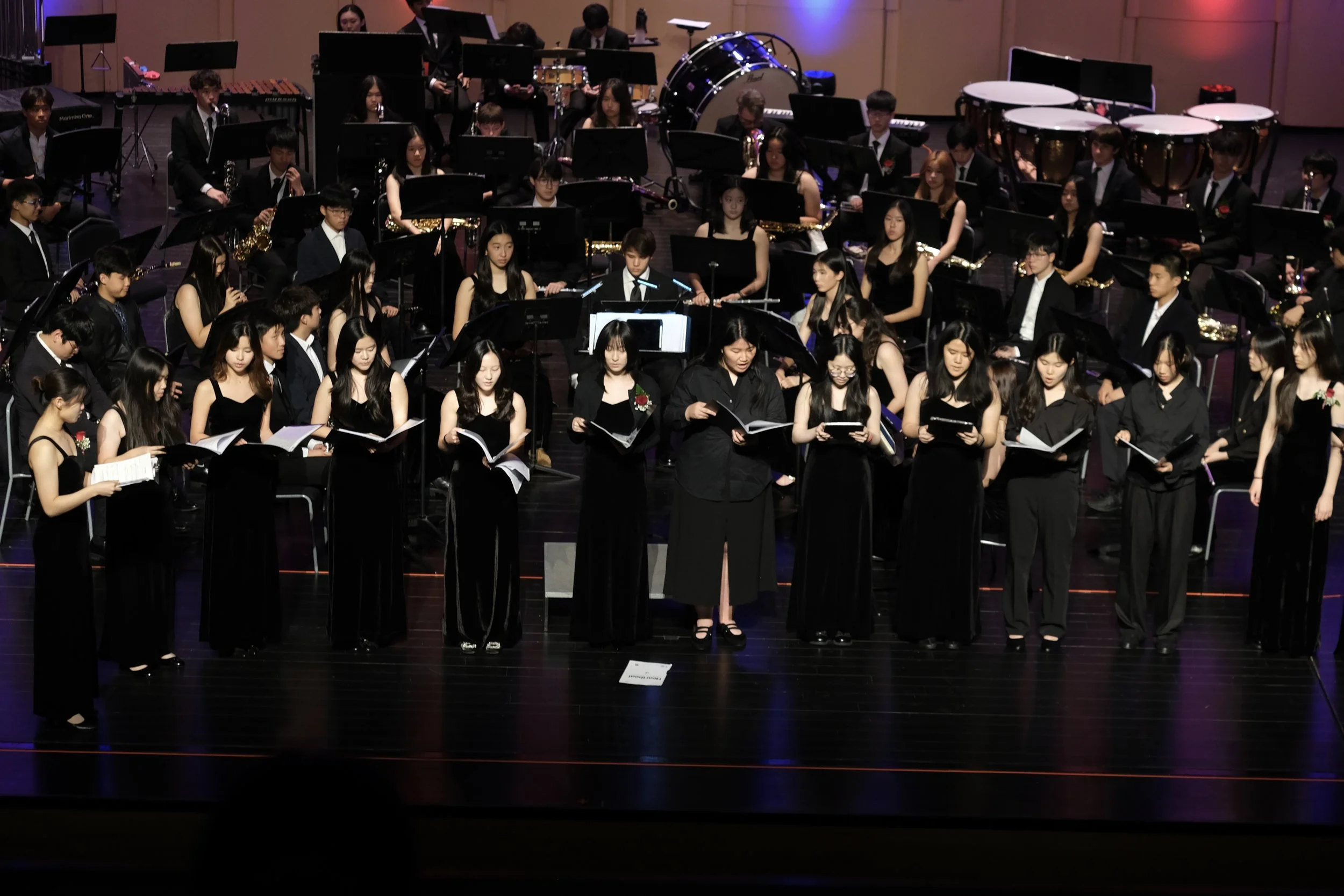
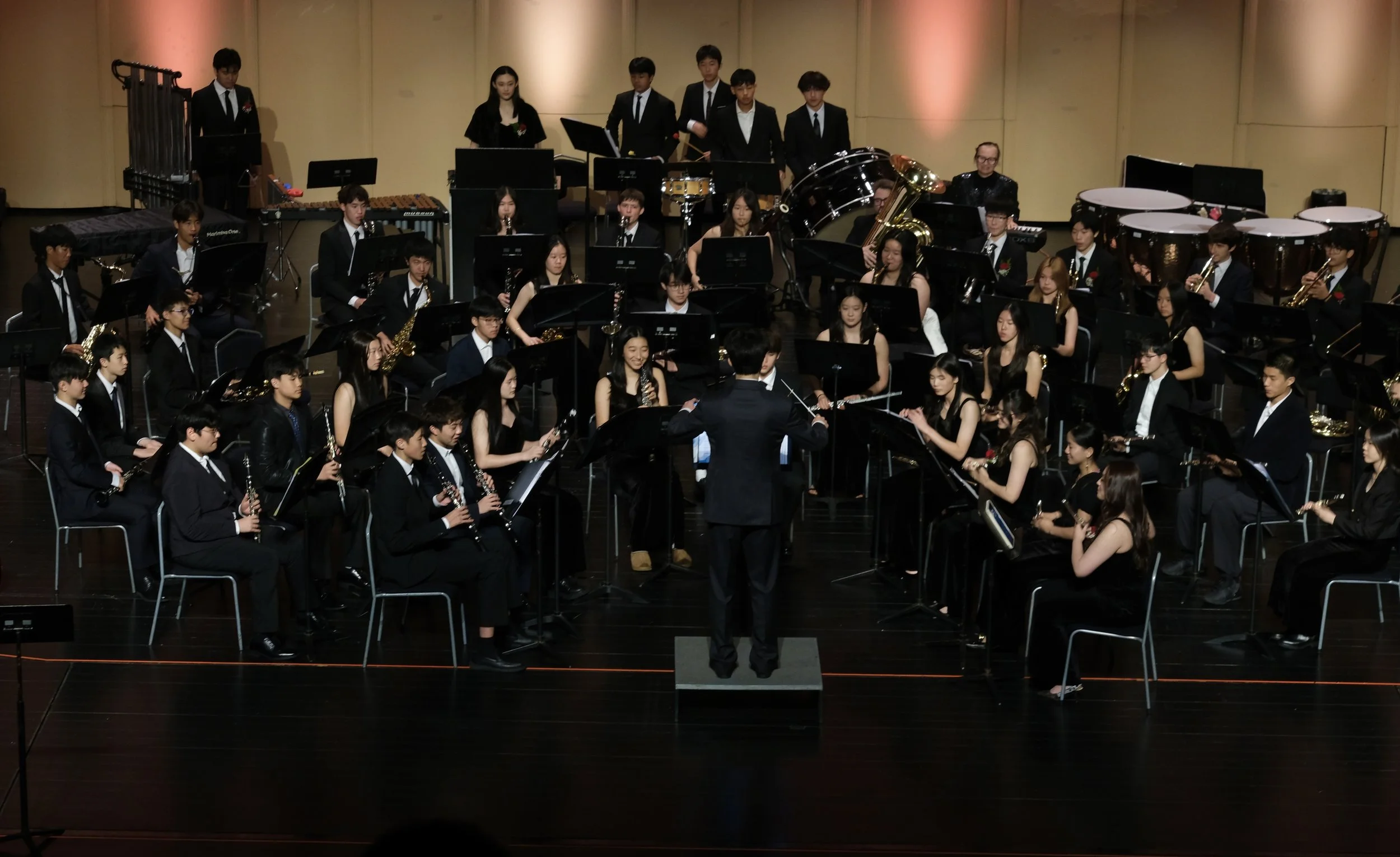
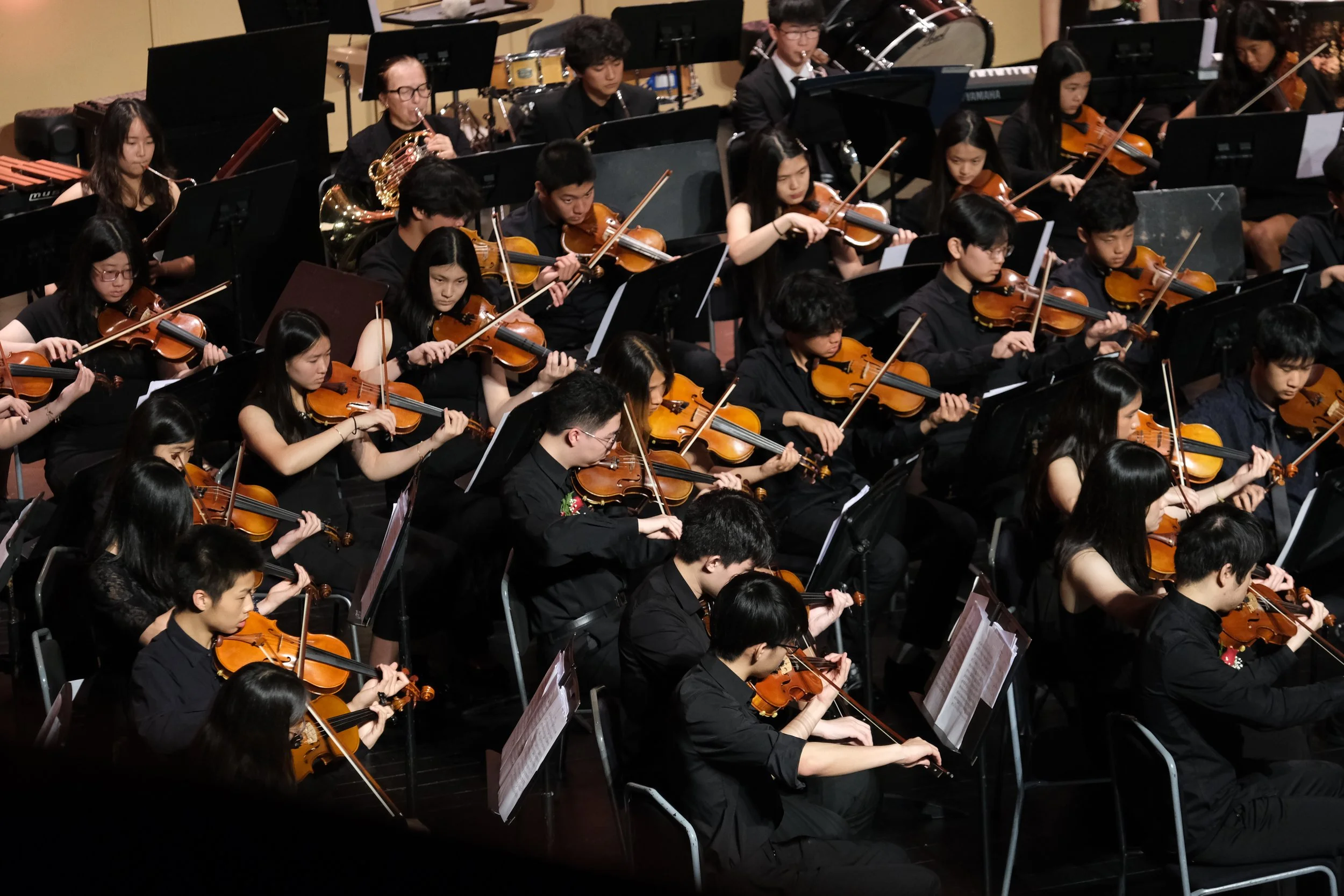
For the Performing Arts department at SASPX, the Spring Concert is one of the year's most anticipated events, combining the disciplines of band, orchestra, choir, and guitar alongside the Puxi Parents Choir on the weekend that showcases the full range of student (and parent!) musical achievement.
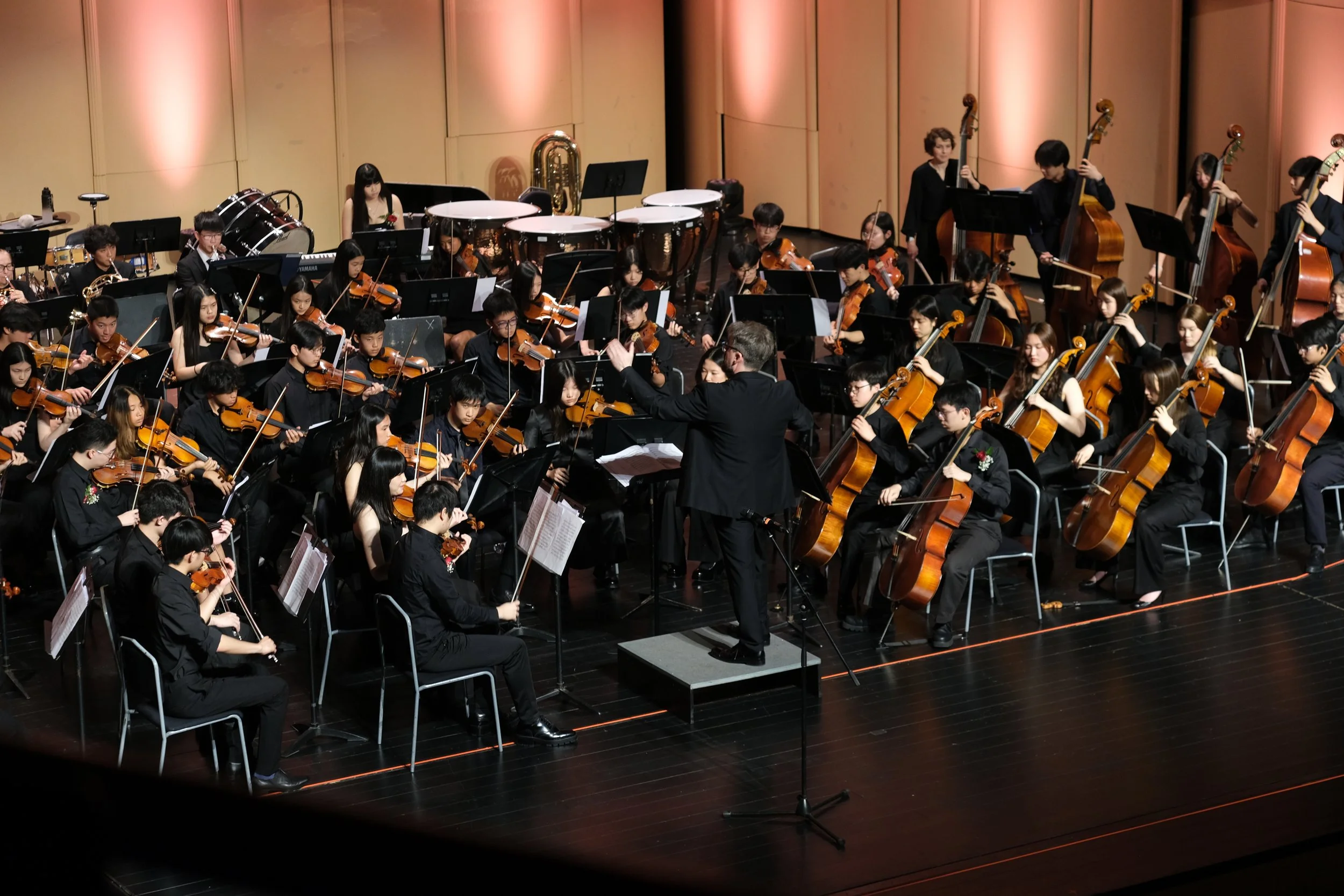
This year's concert opened with the Puxi orchestra, performing a program that consisted of repertoire from both classical and contemporary works, most notably Luigi Boccherini's "Ouverture" from Op. 43, David R. Holsinger's "On a Hymnsong of Philip Bliss," Joe Hisaishi's "Howl's Moving Castle," and "Apotheosis" from Austin Wintory's Journey.
In the second half of the concert, the HS Concert Band started off with Bach’s “Prelude and Fugue in G Minor” before playing 2024 ANCC Winning Composition "Guilin's Majesty" by Benjamin Lau conducted by James L. ‘27 and Rossano Galante's "Cry of the Last Unicorn"; the Guitar ensemble contributed "Romanza," the Pink Panther Theme, and a solo performance from Isshin T. ‘28; the choral portion of the evening featured the High School SSA Choir performing "The Rose," the High School Choir with "Golden Field" and "Lunar Lullaby," and the Puxi Parents Choir under the direction of Christine Qin. Near the end of the concert, the senior celebration wrapped up years of dedication towards the performing arts before the HS Combined Ensembles came together to sing “Heart Beat” by Kyle Pederson and “Connected” by Brian Tate.
IB Music Recap
This year, IB Music students pursued an ambitious range of research topics that reflected the program's commitment to musical curiosity across traditions and genres. From comparative studies of Haitian folk song performance practice to hands-on experiments with prepared piano — using forks and screws to transform the instrument's sound entirely — students approached music as both an academic discipline and a space for creative exploration.
The IB program's emphasis on personal, local, and global musical traditions pushed students well beyond familiar territory. Alongside deep dives into Indian classical music and its tonal construction, students explored genres like punk rock and electronic music, discovering how non-classical influences shape the broader musical landscape. Through neuroplasticity, new listening experiences, and research that connected familiar and unfamiliar music, IB Music students developed a richer and more expansive understanding of what music can be and where it can take them.
Music Research Projects
Christelle H. ‘27:
rrrrrrrondo!
Yatho H. ‘27:
The Girl from Ipanema
Kelly W. ‘27:
Sonata Form Composition
Kelly W. ‘27:
bLack WHiTE grEy
Emma Y. ‘27:
Jumping Lady Bird
Concert Band Recap
For the SAS Puxi band program, this year was defined by storytelling, community, and an unexpected collaboration that brought different pieces to life on stage.
The centerpiece of the concert band's year was "Cry of the Last Unicorn," a piece that pushed students beyond technical execution and into analysis of score composition to understand the meaning behind the piece. The students had to feel the music as a living narrative, to exaggerate the storyline, and to play as if the story were actually unfolding in real time. The goal wasn't just to perform the piece accurately, but to make an audience believe the story of a lonely unicorn, from living a peaceful life to evading capture to ultimately getting away.
One of the band program's quieter but meaningful traditions is Flex Band, an open ensemble that welcomes anyone interested in playing a band instrument regardless if they are in a performing ensemble. It's a space without prerequisites, where students from other disciplines can pick up an instrument and join in. Ms. Pek also welcomes her colleagues to take the stage alongside students, making it one of the few ensembles on campus where teachers and students genuinely perform together as equals.
Last but not least, the one and only Jazz Band's highlight came in October, where they were offered a spot to performing at one of Asia’s biggest jazz festivals, the JZ Jazz Festival, near the Bund. One of the biggest pluses of this event was being able to play for a large crowd, and being able to play classic jazz pieces like Caravan, along with Begin the Beguine with soloist Yatho H. ‘27 marked one of the most successful milestones for the jazz band. Later in March, SAS Puxi partnered with Nanxia Preparatory Academy for a joint practice. The two ensembles came together for an informal musical exchange learning technique from each other, and the type of experience that doesn’t makes it onto the program but ends up being remembered by all.
Orchestra Recap
This year's Spring Concert gave the orchestra a chance to show how far it's come since January. The program spanned centuries and genres: Luigi Boccherini's "Ouverture" from Op. 43, G.521 in D; Joe Hisaishi's "Howl's Moving Castle," arranged by Jiyoung Um; David R. Holsinger's "On a Hymnsong of Philip Bliss"; and "Apotheosis," Austin Wintory's theme from the video game Journey, arranged by Bob Phillips.
Of the four, Mr. Pophal pointed to Apotheosis as the piece that best captured the group's growth. Unlike the first concert of the year, which didn't include a slower piece, Apotheosis was much more technically demanding, and it depended on each section being solid.
"Each section had to be confident in their parts to make the piece sound good," Mr. Pophal explained, noting that the piece put a spotlight on every part of the orchestra rather than letting any one section carry the group. It gave individual students room to step up and contribute on their own. In a slower piece, mistakes are exposed instead of covered up by tempo, so each section had to be able to hold its own part correctly.
That maturity showed in performance, too. Mr. Pophal noted that the group knew the piece well enough that even if a moment got shaky, it wouldn't fall apart — a sign of how far the orchestra had come since those first rehearsals back in January. Comparing a recording from that first rehearsal to the concert on April 29th, the group started with a rough and tentative sound and turned that into a confident, unified voice.
APAC & AMIS Orchestra: Honor Orchestras Recap
Two honor orchestra festivals stood out for SAS musicians this year — one that brought a visiting conductor to campus, and one that sent students across the city.
From November 13th to 15th, SAS Puxi hosted the APAC Orchestra, drawing schools from across the region, including cities throughout China and South Korea. Unlike the usual travel experience, this orchestra came to SASPX's own campus. Students got to rehearse and perform in the comfort of our own campus, while still getting the full honor orchestra experience of playing with and learning from fellow talented musicians and conductors.
Guest conductor Professor Wes Kenney led the ensemble, with a program that included "The Funky Chicken" by American composer David Kechley. It was a fun and unexpected pick that featured funk rhythms and syncopation instead of the classical repertoire orchestra students usually rehearse. Funky Chicken was just as energetic and fun to rehearse and play as it was to hear.
Then, from April 19th to 21st, sister campus SAS Pudong hosted the Association for Music in International Schools' Middle and High School Orchestra Festival (AMSHSO), drawing over 23 schools from across Asia. Every student who attended earned their spot through a competitive audition. The High School Orchestra was led by UK-based conductor Mr. Sebastian See-Schierenberg, while Mr. Pophal himself guest-conducted the Middle School ensemble: 11- to 14-year-olds who had to sit through 90-minute rehearsals. "So much energy," he said, describing how keeping that many young musicians focused meant stretch breaks and, in his words, having to "be goofy on stage."
One moment stuck with Mr. Pophal in particular. As he was getting ready to conduct, he opened his score and found a note of encouragement another teacher had left for him at the beginning, along with a funny message waiting for him at the end. He remembered it as a really sweet, lighthearted gesture. It was a small moment that made the whole experience feel all the more special.
The festival also marked a first for AMIS: an in-person Composers Symposium, led by Mr. Brendan McGibbon, a music educator from Singapore American School, where a small group of aspiring student composers got hands-on experience with the art of composition. It's a chance Mr. Pophal wishes came around more often. Between all the concerts and festivals that fill the year, he said, it can become quite hard to carve out time for composing. But even without any exhaustive music theory knowledge, just free-styling and creating something of your own teaches students a lot: it sharpens their understanding of their own instrument, gets them experimenting with dynamics, and lets them express their own ideas. Even a "surface level" composition, he said, can end up demonstrating real musical concepts a student understood intuitively, before they could even name them.